

Expertise
JA Legal provides a wide range of intellectual property law services in Pakistan, including prosecution, enforcement, and litigation for both rights holders and accused infringers.
JA Legal offers legal consultation and representation to individuals, entrepreneurs, corporations, and national & international organizations seeking intellectual property protection and facing IP infringement claims in Pakistan.
JA Legal’s intellectual property practice covers leading and high-profile cases, including trademark registration and infringement, copyright protection and violation, patent prosecution and disputes, trade secret misappropriation, industrial design registration, geographical indications, software piracy, counterfeiting, passing off, and complex IP licensing disputes.
Our experienced intellectual property lawyers team provides specialized rights-holder and defense-side representation across all types and levels of intellectual property proceedings. We have consistently delivered results in highly sensitive and high-stakes matters and have assisted the superior courts in numerous reported IP cases.
Table of Contents
JA Legal’s Intellectual Property Law services cover interconnected functions, including:
Trademark Registration & Protection: Registering trademarks for individuals and businesses with the Intellectual Property Organization of Pakistan (IPO-Pakistan), conducting trademark searches, filing opposition proceedings, and enforcing trademark rights against infringement, passing-off, and unauthorized use through administrative and judicial channels.
Copyright Registration & Enforcement: Securing copyright registration for literary, artistic, musical, software, and cinematographic works under the Copyright Ordinance 1962, and representing rights holders in infringement disputes before civil courts, including actions for injunctions, damages, and account of profits.
Patent Filing & Prosecution: Filing and prosecuting patent applications before IPO-Pakistan under the Patents Ordinance 2000, conducting patentability assessments, responding to examination objections, and advising on patent scope, claims drafting, and technology licensing strategies tailored to the complexities of Pakistani patent law.
Court Representation Across All Forums: Representing clients before IPO-Pakistan, the Intellectual Property Tribunal, Civil Courts, High Courts of Pakistan, the Supreme Court of Pakistan, and the Federal Constitutional Court of Pakistan in all matters arising from trademark, copyright, patent, and trade secret disputes.
IP Licensing, Assignments & Commercial Agreements: Drafting and negotiating IP licensing agreements, technology transfer contracts, franchise agreements, and assignment deeds that protect clients’ intellectual assets, revenue streams, and territorial rights across commercial transactions in Pakistan.
Urgent Interim Relief & Anti-Piracy Actions: Pursuing urgent injunctions, Anton Piller orders, and seizure applications before competent courts to halt ongoing IP infringement, counterfeit goods distribution, and digital piracy, safeguarding clients’ intellectual property rights and commercial interests throughout the pendency of proceedings.
Post-Decision Relief & Appeals: Advising and representing clients in appeals, revision petitions, and constitutional petitions arising from adverse decisions in IP registration, opposition, and infringement proceedings, from the Intellectual Property Tribunal through to the Supreme Court of Pakistan, with a focus on securing reversals, restoring registration rights, and recovering damages.
How Many Types of Intellectual Property Law Practice Categories Are Offered by JA Legal in Pakistan?
JA Legal offers 9 Intellectual Property law practice categories in Pakistan, covering trademark registration, copyright protection, patent prosecution, trade secret enforcement, industrial design registration, geographical indications, plant breeders’ rights, IP litigation, and border enforcement.
Intellectual property law encompassing trademarks, copyrights, patents, trade secrets, industrial designs, and geographical indications occupies a distinct and complex position within Pakistan’s civil and commercial justice system.
While the foundational procedural architecture remains the Code of Civil Procedure, 1908, these matters are simultaneously governed by a constellation of specialised statutes: the Trade Marks Ordinance, 2001, the Copyright Ordinance, 1962, the Patents Ordinance, 2000, the Registered Designs Ordinance, 2000, and the Geographical Indications (Registration and Protection) Act, 2020, among others.
The interplay between these instruments and the general procedural code creates a layered enforcement regime that distinguishes IP matters from conventional civil proceedings at nearly every stage.
The principal stages, in their proper procedural order, are set out below.
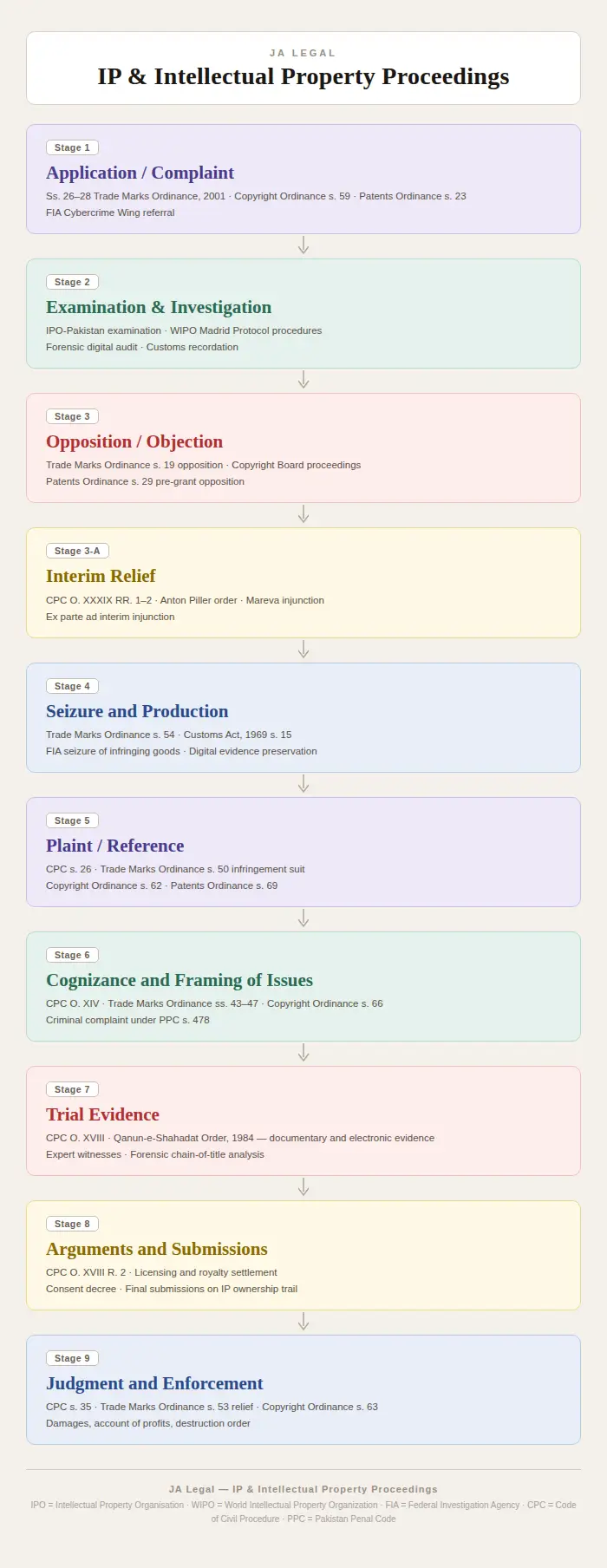
Types of Intellectual Property Cases Handled by JA Legal
JA Legal handles intellectual property matters across the following categories:
Copyright infringement cases, including unauthorized reproduction, distribution, public performance, and digital piracy of literary, musical, artistic, cinematographic, and software works, prosecuted under the Copyright Ordinance, 1962, read with relevant provisions of the Prevention of Electronic Crimes Act, 2016, before IP Tribunals and Civil Courts having jurisdiction under the IPO-Pakistan Act, 2012.
Trademark infringement and passing off cases, involving unauthorized use of registered marks, deceptive similarity, counterfeiting of trade dress, and false representation of origin, prosecuted under the Trade Marks Ordinance, 2001, before the Intellectual Property Tribunal, with appeals to the High Court under Section 62 of the Ordinance, and civil remedies including injunctions and damages before Courts of competent jurisdiction.
Patent infringement cases, involving unauthorized manufacture, use, sale, and importation of patented inventions, prosecuted and adjudicated under the Patents Ordinance, 2000, before IP Tribunals, with enforcement supported by IPO-Pakistan and customs recordation under the Customs Act, 1969, read with the Trade-Related Aspects of Intellectual Property Rights (TRIPS) obligations binding on Pakistan.
Industrial design infringement cases, involving unauthorized copying, imitation, and commercial exploitation of registered designs, adjudicated under the Registered Designs Ordinance, 2000, before Civil Courts and IP Tribunals, with border enforcement measures applicable under the IPO-Pakistan Act, 2012, and applicable SROs issued by the Federal Board of Revenue.
Geographical indications disputes, involving misuse, imitation, and evocation of protected geographical indications for goods including agricultural products, foodstuffs, handicrafts, and textiles, adjudicated under the Geographical Indications (Registration and Protection) Act, 2020, before IP Tribunals, with remedies including cancellation, injunctive relief, and civil damages.
Trade secret misappropriation and confidential information cases, involving unauthorized disclosure, acquisition, and commercial exploitation of proprietary business information, formulas, processes, and technical data, prosecuted under the Pakistan Penal Code, 1860, read with the contract law principles under the Contract Act, 1872, with civil remedies enforced before High Courts exercising original civil jurisdiction.
Plant breeders’ rights infringement cases, involving unauthorized reproduction, sale, export, and commercialization of protected plant varieties, adjudicated under the Plant Breeders’ Rights Act, 2016, before the Plant Breeders’ Rights Office and IP Tribunals, with enforcement coordinated through the Ministry of National Food Security and Research.
Commercial counterfeiting and anti-piracy cases, involving large-scale reproduction, distribution, and sale of counterfeit goods bearing registered trademarks and copyrighted content, prosecuted under the Copyright Ordinance, 1962, the Trade Marks Ordinance, 2001, and the IPO-Pakistan Act, 2012, before IP Tribunals constituted under the IPO Act, with coordinated enforcement by IPO-Pakistan, Federal Investigation Agency, and Pakistan Customs.
Click here and read other Law services offer by JA Legal in Pakistan.
What is the Fee Structure for Intellectual Property Law Services at JA Legal?
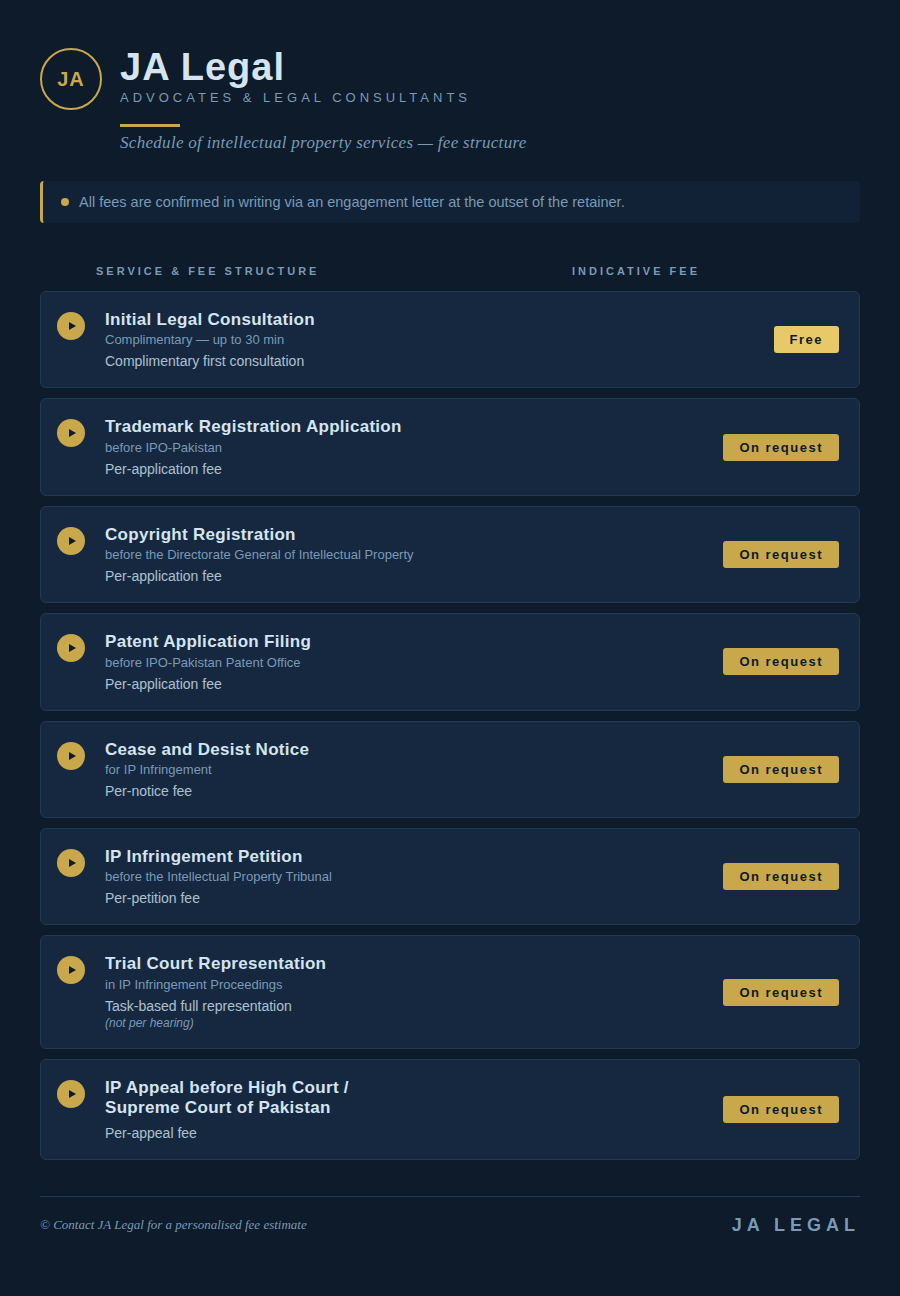
Professional fees in intellectual property matters are determined on a case-by-case basis, having regard to the nature and category of the IP right, the forum of proceedings, the anticipated duration and complexity of the matter, and the seniority of counsel engaged. Fees in a matter involving trademark infringement, copyright piracy, or patent invalidation materially differ from those in a domain name dispute or trade secret misappropriation case.
An indicative summary of the firm’s fee structure for the year 2026 is set out below. Final fee quotations are confirmed in writing via an engagement letter at the outset of the retainer.
How to Engage JA Legal in a Criminal Matter
Prospective clients may engage with the firm through either of the two following channels:
- In-person consultation at the firm’s office in Karachi (suitable for clients based in Karachi or those able to travel);
- Online or virtual consultation (suitable for clients based elsewhere in Pakistan or overseas).
Online and Virtual Consultations
JA Legal offers online and virtual consultations of up to thirty (30) minutes for clients who are unable to attend the firm’s Karachi office in person. The first such consultation is offered without charge. Appointments may be scheduled through any of the following:
- The contact form available on the firm’s website;
- WhatsApp;
- Direct telephone call through the firm’s Google Business Profile.
Where can I schedule an online/virtual consultation with a Criminal Defense Lawyer at JA Legal?
There are 5 simple steps to book your 30-minute online consultation with the JA Legal lawyer team.
- Contact via website, WhatsApp, or directly call from GMB(Google My Business profile)
- Provide a short description of the criminal matter, the type of offense you are facing
- Confirm your appointment date, time, and consultation fee structure with the JA Legal intake team.
- Confirm the availability of the JA Legal lawyer team on the same day as your meeting is scheduled.
- Prepare the relevant documents that convey your case details, including a copy of the FIR, arrest record, and court notices.