
Expertise
JA Legal provides a broad range of shipping and maritime law services in Pakistan, including trial advocacy for both claimants and vessel operators.
JA Legal offers legal consultation and representation to individuals, shipping companies, port authorities, corporations, and national & international organizations facing maritime disputes and seeking to initiate maritime proceedings in Pakistan.
JA Legal shipping and maritime law practice covers leading and high-profile cases, including vessel arrests, cargo disputes, charter party breaches, marine insurance claims, collision liability, port state control detentions, freight recovery, ship financing defaults, crew claims, smuggling offenses, and complex admiralty matters.
Our experienced maritime lawyers team provides specialized claimant and respondent-side representation across all types and levels of admiralty and shipping proceedings. We have consistently delivered results in highly sensitive and high-stakes maritime matters and have assisted the superior courts in numerous reported admiralty cases.
Table of Contents
JA Legal’s shipping and maritime law services cover five interconnected functions, including:
- Vessel Representation: Representing shipowners, charterers, and cargo interests from dispute initiation to final resolution through strong advocacy, legal challenges, witness examination, and procedural objections.
- Maritime Rights Protection: Ensuring that shipowners, seafarers, and cargo claimants receive due process, fair hearing rights, and statutory protections under the Merchant Shipping Ordinance, 2001, the Carriage of Goods by Sea Act, 1925, and applicable admiralty jurisdiction.
- Legal Consultation: Providing case-specific legal advice on charter party disputes, bills of lading, cargo claims, ship arrest procedures, marine insurance, and overall maritime litigation strategy.
- Court Representation: Representing clients before all relevant courts and forums, including, but not limited to, Civil Courts, High Courts exercising admiralty jurisdiction, the Supreme Court of Pakistan, and applicable maritime arbitration tribunals.
- Dispute Resolution & Appeals: Advising and representing clients in relation to appeals, revision petitions, arbitration enforcement, and other remedies before Appellate Courts from High Courts to the Supreme Court of Pakistan.
What Are the Stages of a Shipping & Maritime Case in Pakistan?
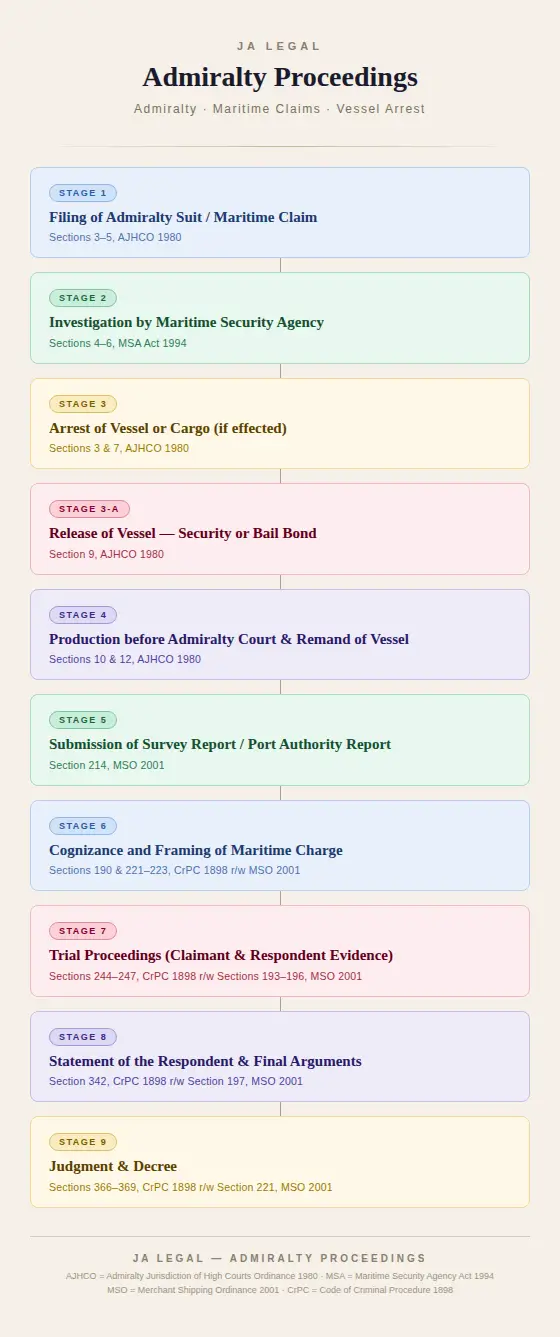
The trial of a shipping and maritime case in Pakistan is governed primarily by the Merchant Shipping Ordinance, 2001 (“MSO”), read together with the Admiralty Jurisdiction of High Courts Ordinance, 1980 (“AJHCO”) and the Pakistan Ports Act, 1889 (“PPA”).
The principal stages, in their proper procedural order, are set out below.
What Shipping & Maritime Law Services Are Offered by JA Legal?
JA Legal advises and represents clients across the full spectrum of shipping and maritime law in Pakistan, with a practice covering admiralty litigation under the Admiralty Jurisdiction of High Courts Ordinance, 1980, as well as proceedings under specialized statutes governing vessel arrests, cargo claims, port operations, and marine insurance.
The firm’s maritime lawyers appear before the High Court of Sindh (Admiralty Side), Port Adjudication Authorities, and, in appropriate matters, the Supreme Court of Pakistan.
The firm’s shipping and maritime law practice is organized into the following five principal service areas:
| No. | Service Area | Scope of Engagement |
| 1 | Vessel Arrest, Release & Admiralty Actions | Pre-arrest advisory, arrest and release of vessels under the Admiralty Jurisdiction of High Courts Ordinance, 1980; representation in rem and in personam proceedings; security for maritime claims and caveat entries |
| 2 | Cargo Claims & Freight Disputes | Representation of shippers, consignees, and carriers in cargo loss, damage, and short-delivery claims; disputes under bills of lading, sea waybills, and charter parties before trial courts and arbitral tribunals |
| 3 | Marine Insurance & P&I Club Matters | Representation in hull and machinery claims, protection and indemnity disputes, and cargo insurance proceedings under the Marine Insurance Act, 1906 (as applicable in Pakistan); coverage disputes and subrogation actions |
| 4 | Port, Customs & Regulatory Proceedings | Representation before the Pakistan Ports Authority, Karachi Port Trust, Port Qasim Authority, and Pakistan Customs in detention, confiscation, demurrage, and regulatory compliance matters under the Customs Act, 1969 and Port Trusts Acts |
| 5 | Appeals, Arbitration & Constitutional Remedies | Maritime appeals and revisions before the High Court of Sindh and the Supreme Court of Pakistan; enforcement of foreign arbitral awards under the Recognition and Enforcement (Arbitration Agreements and Foreign Arbitral Awards) Act, 2011; constitutional petitions under Article 199 challenging unlawful vessel detention and procedural irregularities in admiralty proceedings |
Detailed Description of Each Shipping & Maritime Law Service Area
1. Pre-Dispute Advisory and Vessel Arrest Practice
The firm advises clients at the earliest stages of a maritime dispute, including upon registration of a shipping claim and during port state control investigations. The practice in this area includes:
- Pre-arrest advisory on vessel arrest applications under the Admiralty Jurisdiction of High Courts Ordinance, 1980 before the High Court of Sindh at Karachi;
- Arrest and release applications for sister ships and associated vessels under Section 3 of the Admiralty Jurisdiction Ordinance, 1980, including matters involving maritime liens and possessory claims;
- Representation at the stage of port detention and vessel inspection under the Merchant Shipping Ordinance, 1960 and applicable Port Authority regulations;
- Challenge petitions under constitutional jurisdiction under Article 199 of the Constitution of the Islamic Republic of Pakistan, 1973, where detention orders or enforcement proceedings disclose no valid maritime claim or are vitiated by procedural irregularities;
- Advisory in connection with registration, transfer, mortgage, and cancellation of vessel documentation under the Pakistan Merchant Shipping Ordinance, 1960.
2. Admiralty Court Representation and Maritime Defense
The firm represents shipowners, charterers, cargo interests, and P&I clubs in admiralty proceedings before the High Court of Sindh and across Pakistan’s port jurisdictions. Representation extends from the filing of an admiralty suit to the pronouncement of judgment, and includes:
- Arguments on jurisdiction and admissibility of admiralty claims under Sections 3 and 4 of the Admiralty Jurisdiction of High Courts Ordinance, 1980, and applications for striking out or dismissal of unmeritorious claims;
- Cross-examination of witnesses in accordance with the Qanun-e-Shahadat Order, 1984, in matters involving collision, general average, and cargo damage;
- Drafting and filing of written statements, counterclaims, and third-party notices in complex multi-party maritime disputes;
- Conduct of final arguments and submission of written synopses in high-value freight, demurrage, and salvage disputes;
- Defense and prosecution of claims under the Merchant Shipping Ordinance, 1960, the Carriage of Goods by Sea Act, 1925, the Pakistan Ports Act, 1908, and applicable international maritime conventions ratified by Pakistan.
3. Maritime Fraud, Customs & Regulatory Matters
The firm maintains a dedicated maritime fraud and regulatory practice, with substantial experience in matters before specialized investigative agencies, customs tribunals, and admiralty courts. This includes:
- Proceedings under the Customs Act, 1969, including representation at inquiry, adjudication, and appellate stages before the Collector of Customs and the Customs Appellate Tribunal;
- Matters before the Federal Investigation Agency under the Federal Investigation Agency Act, 1974, involving bill of lading fraud, cargo misappropriation, and shipping document forgery;
- Cases under the Anti-Money Laundering Act, 2010, including representation in proceedings involving freight payment structuring, trade-based money laundering, and ship financing irregularities;
- Cybercrime and digital fraud under the Prevention of Electronic Crimes Act, 2016 (“PECA”), involving electronic bills of lading, fraudulent shipping instructions, and vessel tracking manipulation;
- Connected constitutional and writ petitions challenging the legality of customs seizures, vessel detentions, and regulatory enforcement actions.
4. Cargo Claims, Freight Disputes & Private Maritime Complaints
Where a dispute does not involve vessel arrest or where commercial resolution through court proceedings is more appropriate, the firm files and conducts maritime claims on behalf of cargo owners, freight forwarders, and shipping agents. This area of practice includes:
- Filing of admiralty suits and private complaints under the Carriage of Goods by Sea Act, 1925, and the Hague-Visby Rules as applicable, including conduct of pre-trial evidence on short delivery, damage, and misdelivery;
- Representation of cargo interests and shippers at trial, including in cases of freight overcharge, demurrage disputes, lien enforcement, and marine insurance subrogation;
- Applications for release of arrested vessels and counter-security under the Admiralty Jurisdiction Ordinance, 1980;
- Applications for survey orders, appointment of independent superintendents, and protection of perishable cargo evidence.
5. Appeals, Arbitration, and Constitutional Remedies in Maritime Matters
The firm represents clients in post-judgment proceedings before appellate forums, international arbitration tribunals, and in connected constitutional petitions. The scope of this practice includes:
- Appeals against admiralty decrees before the Division Bench of the High Court of Sindh and, where competent, the Supreme Court of Pakistan;
- Revisions and review applications in maritime matters under the Civil Procedure Code, 1908, and the Admiralty Jurisdiction Ordinance, 1980;
- International maritime arbitration under LMAA, SCMA, or ad hoc arbitral rules, including enforcement of foreign arbitral awards in Pakistan under the Recognition and Enforcement (Arbitration Agreements and Foreign Arbitral Awards) Act, 2011;
- Constitutional petitions under Article 199 of the Constitution challenging unlawful vessel detention, malicious maritime proceedings, port authority excess of jurisdiction, and illegality of orders passed by admiralty courts;
- Petitions for special leave to appeal before the Supreme Court of Pakistan under Article 185 of the Constitution in landmark shipping and maritime law matters.
Click here and read other Law services offer by JA Legal in Pakistan.
What is the Fee Structure for Shipping & Maritime Law Services at JA Legal?
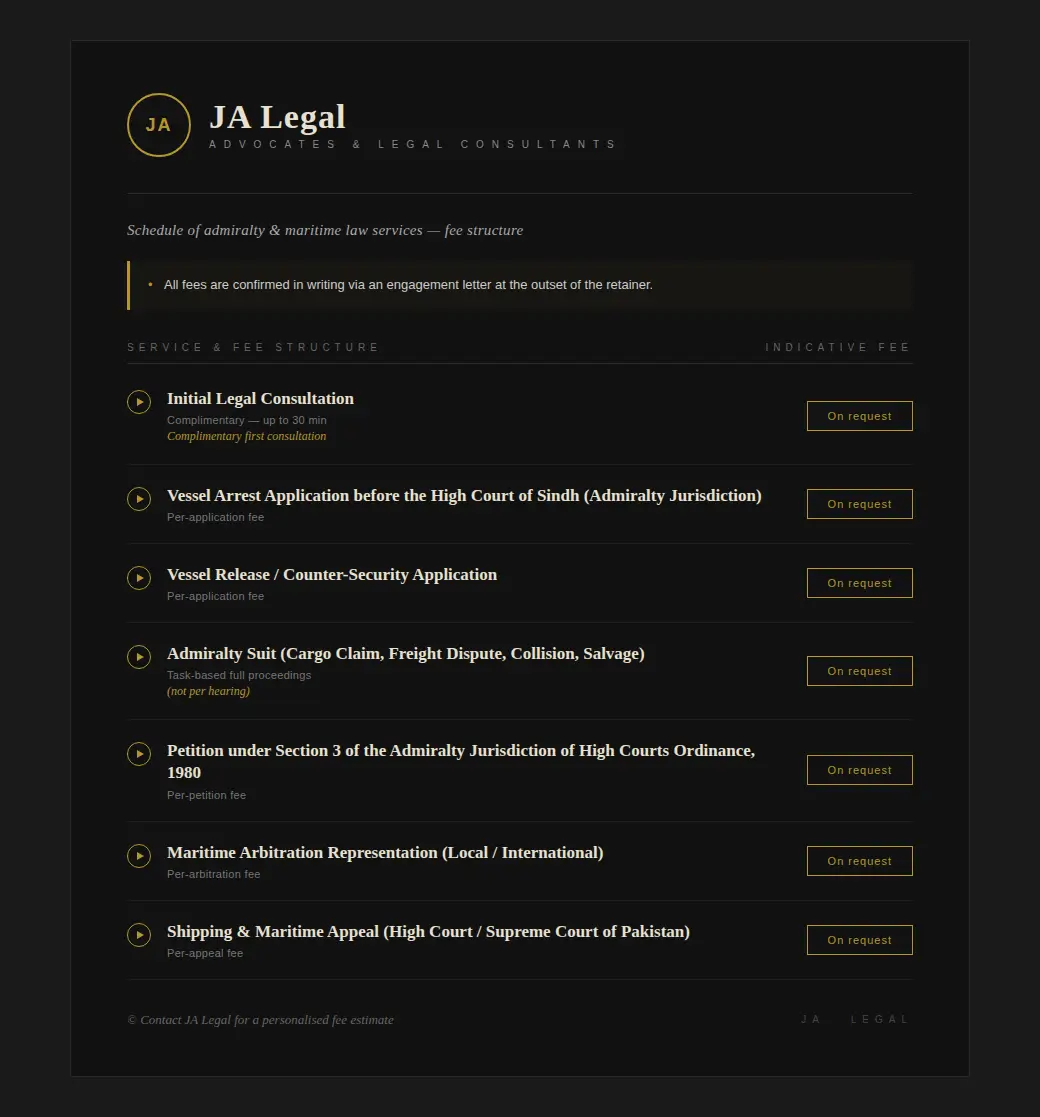
Professional fees in shipping and maritime matters are determined on a case-by-case basis, having regard to the nature and complexity of the maritime dispute, the forum of proceedings, the anticipated duration of litigation or arbitration, and the seniority of counsel engaged.
By way of illustration, fees in a matter involving arrest of a vessel under the Admiralty Jurisdiction of the High Court will materially differ from those payable in a matter involving a comparatively less complex cargo claim or freight dispute.
An indicative summary of the firm’s fee structure for the year 2026 is set out below. Final fee quotations are confirmed in writing via an engagement letter at the outset of the retainer.
How to Engage JA Legal in a Criminal Matter
Prospective clients may engage with the firm through either of the two following channels:
- In-person consultation at the firm’s office in Karachi (suitable for clients based in Karachi or those able to travel);
- Online or virtual consultation (suitable for clients based elsewhere in Pakistan or overseas).
Online and Virtual Consultations
JA Legal offers online and virtual consultations of up to thirty (30) minutes for clients who are unable to attend the firm’s Karachi office in person. The first such consultation is offered without charge. Appointments may be scheduled through any of the following:
- The contact form available on the firm’s website;
- WhatsApp;
- Direct telephone call through the firm’s Google Business Profile.