

Expertise
JA Legal provides a broad range of criminal law services in Pakistan, including trial advocacy for both complainants and accused.JA Legal offers legal consultation and representation to provide individuals, government servants, corporations, and national & international organizations facing criminal charges and seeking to initiate criminal proceedings in Pakistan.
JA Legal criminal law practice covers leading and high-profile cases, including murder, criminal breach of trust, fraud, corruption, narcotics, banking and finance offenses, white-collar crime, cybercrime, smuggling, false accusations, and complex police matters.
Our experienced criminal lawyers team provides specialized defense and prosecution-side representation across all types and levels of criminal proceedings. We have consistently delivered results in highly sensitive and high-stakes matters and have assisted the superior courts in numerous reported cases.
Table of Contents
JA Legal’s criminal law services cover 5 interconnected functions, including:
- Criminal Defense: Defending accused persons from conviction to mitigating the sentences through strong representation/advocacy, legal challenges, witness examination, and procedural objections.
- Justice Advocacy: Ensuring that accused persons receive due process, fair trial rights, and constitutional protections under Articles 9, 10, and 10-A of the Constitution of Pakistan, 1973.
- Legal Consultation: Providing case-specific legal advice on strategy, criminal charges, bail options, plea considerations, and overall criminal trial strategy.
- Court Representation: Representing clients before all the relevant courts, including, but not limited to, Judicial Magistrate Courts, Sessions Courts, High Courts of Pakistan, the Supreme Court of Pakistan, and the Federal Constitutional Court of Pakistan.
- Post-Conviction Relief: Advising and representing clients in relation to appeals, criminal revision petitions, and other remedies before the Appellate Courts from High Courts to the Supreme Court of Pakistan.
What Are the Stages of a Criminal Case in Pakistan?
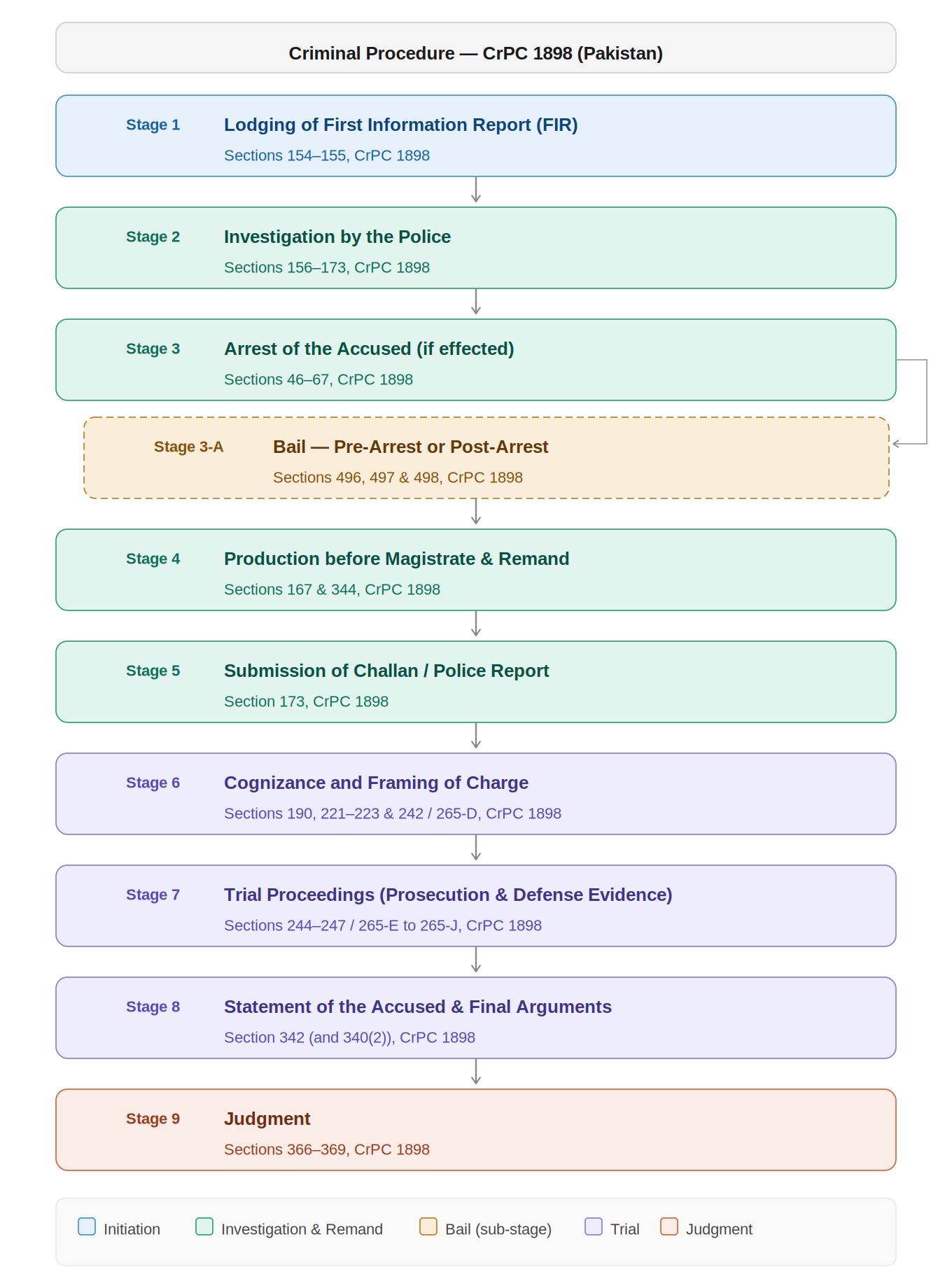
The trial of a criminal case in Pakistan is governed primarily by the Code of Criminal Procedure, 1898 (“CrPC”), read together with the Pakistan Penal Code, 1860 (“PPC”) and the Qanun-e-Shahadat Order, 1984 (“QSO”).
The principal stages, in their proper procedural order, are set out below.
What Criminal Law Services Are Offered by JA Legal?
JA Legal advises and represents clients across the full spectrum of criminal law in Pakistan, with a practice covering ordinary criminal litigation under the Pakistan Penal Code, 1860 (“PPC”), as well as proceedings under specialized statutes governing white-collar crime, financial offenses, and cybercrime.
The firm’s criminal lawyers appear before Magistrates, the Courts of Session, the High Court of Sindh, and, in appropriate matters, the Supreme Court of Pakistan.
The firm’s criminal law practice is organized into the following five principal service areas:
| No. | Service Area | Scope of Engagement |
| 1 | Pre-Trial Advisory and Bail Practice | Pre-arrest and post-arrest bail; representation at remand and advisory on FIR registration; quashment (if advised) |
| 2 | Trial Court Representation and Criminal Defense | Representation of the accused in trials before Magistrates and the Courts of Session under the Code of Criminal Procedure, 1898; framing of charge, cross-examination of prosecution witnesses, recording of statements under Section 342, and advocacy for final arguments. |
| 3 | White-Collar Crime, NAB & FIA Matters | Representation in proceedings under the National Accountability Ordinance, 1999, the Federal Investigation Agency Act, 1974, the Anti-Money Laundering Act, 2010, and the Prevention of Electronic Crimes Act, 2016, including inquiries, investigations, references, and connected constitutional petitions. |
| 4 | Private Complaints and Prosecution | Filing and conduct of private criminal complaints under Section 200 of the Code of Criminal Procedure, 1898; representation of complainants and victims; and applications for cancellation of bail and re-investigation. |
| 5 | Appeals, Revisions, and Constitutional Remedies | Criminal appeals, revisions, and references before the High Court of Sindh and the Supreme Court of Pakistan; constitutional petitions under Article 199 challenging illegal detention, and procedural irregularities in criminal proceedings. |
Detailed Description of Each Criminal Law Service Area
1. Pre-Trial Advisory and Bail Practice
The firm advises clients at the earliest stages of a criminal matter, including upon registration of a First Information Report (“FIR”) and during the police investigation. The practice in this area includes:
- Pre-arrest bail applications under Section 498 of the CrPC before the Court of Session and the High Court;
- Post-arrest bail applications under Sections 496 and 497 of the CrPC, including matters falling within the prohibitory clause of Section 497(1);
- Representation at the stage of physical and judicial remand under Section 167 of the CrPC;
- Quashment petitions under Section 561-A of the CrPC and constitutional petitions under Article 199 of the Constitution of the Islamic Republic of Pakistan, 1973, where the FIR or proceedings disclose no offense or are vitiated by mala fides;
- Advisory in connection with the registration, transfer, and cancellation of FIRs.
2. Trial Court Representation and Criminal Defense
The firm represents accused persons in criminal trials before Magistrates and the Courts of Session in Karachi and across Sindh. The scope of representation extends from the framing of charge to the pronouncement of judgment, and includes:
- Arguments on the framing of charge under Sections 242 and 265-D of the CrPC, and applications for discharge or acquittal under Section 249-A and 265-K;
- Cross-examination of prosecution witnesses in accordance with the Qanun-e-Shahadat Order, 1984;
- Recording and drafting of statements of the accused under Section 342 of the CrPC, and on oath under Section 340(2);
- Conduct of final arguments and submission of written synopses;
- Defense in cases under the PPC, the Anti-Terrorism Act, 1997, the Control of Narcotic Substances Act, 1997, and other substantive criminal statutes.
3. White-Collar Crime, NAB & FIA Matters
The firm has a dedicated white-collar and financial crime practice, with substantial experience in matters before specialized investigative agencies and accountability courts. This includes:
- Proceedings under the National Accountability Ordinance, 1999, including representation at the inquiry, investigation, and reference stages before the Accountability Courts;
- Matters before the Federal Investigation Agency under the Federal Investigation Agency Act, 1974;
- Cases under the Anti-Money Laundering Act, 2010, including representation in connection with proceedings of the Financial Monitoring Unit and prosecution before the relevant courts;
- Cybercrime and digital offenses under the Prevention of Electronic Crimes Act, 2016 (“PECA”);
- Connected constitutional and writ petitions challenging the legality of inquiries, investigations, and arrests.
4. Private Complaints and Prosecution
Where the matter does not call for police investigation or where private redress is more appropriate, the firm files and conducts private criminal complaints on behalf of complainants and victims. This area of practice includes:
- Filing of private complaints under Section 200 of the CrPC and conduct of pre-summoning evidence;
- Representation of complainants and victims at trial, including in cases of fraud, breach of trust, defamation, hurt, and harassment;
- Applications for cancellation of bail under Section 497(5) of the CrPC;
- Applications for re-investigation, transfer of investigation, and protection of witnesses.
5. Appeals, Revisions, and Constitutional Remedies
The firm represents clients in post-trial proceedings before the appellate and revisional fora, as well as in connected constitutional petitions. The scope of this practice includes:
- Criminal appeals against conviction or acquittal before the High Court of Sindh and, where competent, the Supreme Court of Pakistan;
- Criminal revisions under Sections 435 and 439 of the CrPC;
- Criminal references and confirmation proceedings;
- Constitutional petitions under Article 199 of the Constitution challenging illegal detention, malicious prosecution, procedural irregularities, and the legality of orders passed by criminal courts;
Petitions for special leave to appeal before the Supreme Court of Pakistan under Article 185 of the Constitution.
Types of Criminal Cases Handled at JA Legal in Pakistan
Pakistan Penal Code Offenses
- Murder cases(Causing death without full intention to kill)
- Cases of theft, robbery, and dacoity cases
- Fraud, cheating, and forgery cases
- Kidnapping and abduction cases
- Defamation and libel cases.
Special Statute Offense
- Drug offenses: under the Control of Narcotic Substances Act, 1997 (CNSA), read with the Anti-Narcotics Force Act, 1997.
- Terrorism offenses: under the Anti-Terrorism Act, 1997 (ATA), tried by Anti-Terrorism Courts.
- Cybercrime offenses: under the Prevention of Electronic Crimes Act, 2016 (PECA), investigated by the National Cyber Crime Investigation Agency (NCCIA, successor to FIA Cyber Crime Wing).
- Corruption offenses: under the National Accountability Ordinance, 1999 (NAB Ordinance); the Federal Investigation Agency Act, 1974; and provincial anti-corruption establishment laws (e.g., Sindh Inquiries and Anti-Corruption Act, 1991). Tried by the Accountability Courts / Special Judges Anti-Corruption.
- Tax evasion offenses: under Income Tax Ordinance, 2001; Sales Tax Act, 1990; Federal Excise Act, 2005; and provincial revenue statutes (Sindh Sales Tax on Services Act, 2011; Punjab Sales Tax on Services Act, 2012; etc.). Enforced by FBR/SRB/PRA, with Special Judges (Customs, Taxation & Anti-Smuggling) for prosecution.
- Money laundering offenses: under the Anti-Money Laundering Act, 2010 (AMLA), read with the National Anti-Money Laundering and Counter Financing of Terrorism Authority Act, 2023, and AML/CFT regulations issued by SBP, SECP, and FMU.
- Banking fraud and financial offenses: under Offenses in Banks (Special Courts) Ordinance, 1984; Financial Institutions (Recovery of Finances) Ordinance, 2001; Banking Companies Ordinance, 1962; read with relevant PPC offenses and AMLA, 2010.
- Human trafficking and migrant smuggling: under the Prevention of Trafficking in Persons Act, 2018 (PTPA) and the Prevention of Smuggling of Migrants Act, 2018; investigated by FIA.
- Arms and weapons offenses: under Pakistan Arms Ordinance, 1965 and the Surrender of Illicit Arms Act, 1991; provincial Arms Acts/Rules (e.g., Punjab Arms Ordinance / Sindh Arms Act, 2013; Khyber Pakhtunkhwa Arms Act, 2013).
- Customs and smuggling offenses: under the Customs Act, 1969, read with the Anti-Smuggling Provisions and the Prevention of Smuggling Act, 1977; tried before Special Judges (Customs & Taxation) and the Customs Appellate Tribunal.
- Securities and financial fraud offenses: under the Securities Act, 2015; the Companies Act, 2017; the Futures Market Act, 2016; the Anti-Money Laundering Act, 2010; and the Securities and Exchange Commission of Pakistan Act, 1997, enforced by SECP, with appeals to the SECP Appellate Bench and the Appellate Tribunal under the Securities Act.
- Foreign exchange offenses: under the Foreign Exchange Regulation Act, 1947 (FERA), read with the Protection of Economic Reforms Act, 1992, and SBP’s Foreign Exchange Manual; enforced through FIA and SBP, prosecuted before Special Judges (Customs & Taxation).
- Intellectual property offenses: under the Copyright Ordinance, 1962; the Trade Marks Ordinance, 2001, and the Intellectual Property Organization of Pakistan Act, 2012. Civil and criminal proceedings lie before the IP Tribunals constituted under the IPO Act.
What is the Fee Structure for Criminal Law Services at JA Legal?
Professional fees in criminal matters are determined on a case-by-case basis, having regard to the nature and gravity of the offense, the forum of trial, the anticipated duration and complexity of the proceedings, and the seniority of counsel engaged. By way of illustration, fees in a matter involving an offense punishable with death or imprisonment for life, such as one falling under Section 302 of the Pakistan Penal Code, 1860, will materially differ from those payable in a matter involving a comparatively less grave offense.
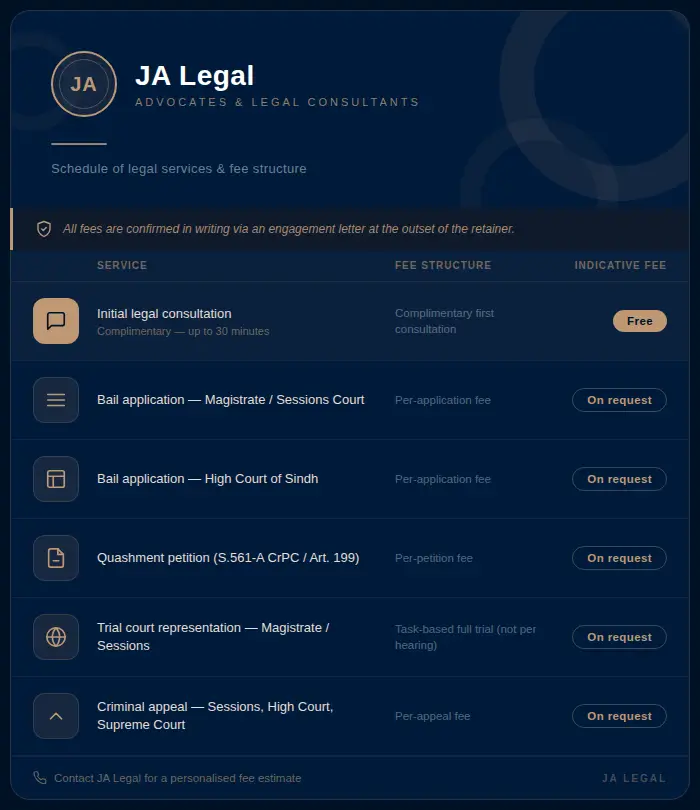
An indicative summary of the firm’s fee structure for the year 2026 is set out below. Final fee quotations are confirmed in writing via an engagement letter at the outset of the retainer.
| Law Service Category | Fee Structure | Price Range(Depends on case) |
| Initial legal consultation for every type of case | The first 30-minute online consultation is free, and after that, there is a fixed fee per session | Contact the JA Legal team for Price |
| Bail application to the Magistrate | Per application fee | Contact the JA Legal team for Price |
| Bail application to the High Court | Per Application fee | Contact the JA Legal team for Price |
| FIR quashing petition service | Per Petition fee | Contact the JA Legal team for Price |
| Full trial defense | Per case fee | Contact the JA Legal team for Price |
| Appeal in the session, the high court, and the supreme court | Per appeal fee | Contact the JA Legal team for Price |
| Online Consultation for law service | First 30 minutes free consultation, then fixed fee per session | Contact the JA Legal team for Price |
How to Engage JA Legal in a Criminal Matter
Prospective clients may engage with the firm through either of the two following channels:
- In-person consultation at the firm’s office in Karachi (suitable for clients based in Karachi or those able to travel);
- Online or virtual consultation (suitable for clients based elsewhere in Pakistan or overseas).
Online and Virtual Consultations
JA Legal offers online and virtual consultations of up to thirty (30) minutes for clients who are unable to attend the firm’s Karachi office in person. The first such consultation is offered without charge. Appointments may be scheduled through any of the following:
- The contact form available on the firm’s website;
- WhatsApp;
- Direct telephone call through the firm’s Google Business Profile.
What is the process to schedule an online JA Legal appointment?
There are 5 simple steps to book your 30-minute online consultation with the JA Legal lawyer team.
- Contact via website, WhatsApp, or directly call from GMB(Google My Business profile)
- Provide a short description of the criminal matter, the type of offense you are facing
- Confirm your appointment date, time, and consultation fee structure with the JA Legal intake team.
- Confirm the availability of the JA Legal lawyer team on the same day as your meeting is scheduled.
- Prepare the relevant documents that convey your case details, including a copy of the FIR, arrest record, and court notices.
Notable Representations in Criminal Matters
Over the years, members of the firm have had the privilege of appearing in a number of criminal matters that have attracted considerable public and judicial attention, several of which have raised questions of constitutional importance or contributed to the development of criminal jurisprudence in Pakistan.
A selection of those matters is set out below, not by way of self-promotion, but to give some sense of the nature and texture of the work the firm has been called upon to undertake.
Reference Concerning the Late Prime Minister Zulfiqar Ali Bhutto
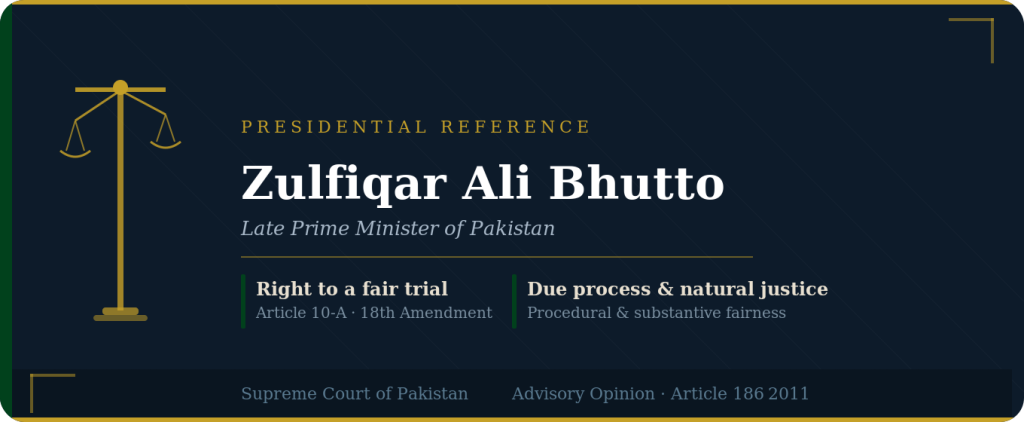 The firm appeared in the Presidential Reference seeking reconsideration of the trial and conviction of the late Prime Minister, Mr. Zulfiqar Ali Bhutto. The arguments advanced in the Reference proceeded on the footing that the original trial had not satisfied the standards of a fair trial, and that the conviction could not, in those circumstances, be regarded as having been arrived at in accordance with law.
Beyond its historical resonance, the Reference raised questions of enduring constitutional significance concerning the right to a fair trial, due process, and the manner in which the judicial record of an earlier era may be revisited.
Mustafa Amir Murder Case
 The firm represented the complainant side in the murder trial concerning the death of Mr. Mustafa Amir, a matter that drew sustained national attention. Beyond the facts, the case engaged broader concerns about the responsiveness of the criminal justice system to victims and their families, the integrity of the investigation, and the procedural safeguards that ought to attend a high-profile prosecution.
Shehzad Kaleh Khan Case
 The firm appeared before the Honorable High Court in the Shehzad Kaleh Khan matter, in proceedings that resulted in a judgment of significant precedential value. The case turned on questions which have since been relied upon in subsequent matters of a similar character.
Rao Anwar Murder Trial
 The firm represented the accused in the Rao Anwar matter, a trial that was followed closely both within and beyond the legal community on account of the sensitivities involved. The defense was conducted strictly on procedural and evidentiary lines, and the trial concluded in an acquittal.
The matter was, in its conduct as much as in its outcome, a reminder that even the most publicly scrutinized prosecution must rise or fall on the strength of the evidence led in court.
Umme Rabab Case
 The firm represented a politically prominent figure in the Umme Rabab murder trial, a matter that attracted nationwide attention and prompted public discourse on questions of justice, the exercise of influence, and the operation of due process in cases involving persons of consequence.
The conduct of the defense sought to ensure that the matter was tried on its legal merits, free from extraneous considerations.
Nasla Tower Proceedings
 The firm represented a senior bureaucrat in proceedings arising out of the Nasla Tower demolition, a matter that engaged not only criminal and regulatory questions but also broader issues of urban planning, accountability of public functionaries, and the limits of executive action. A favorable outcome was secured for the client.
Bahria Town and Bahria Icon Tower Matters
 The firm has appeared on behalf of leading corporate entities in proceedings arising out of allegations of illegal allotment and regulatory non-compliance in connection with the Bahria Town and Bahria Icon Tower projects.
The matters raised questions of considerable complexity at the intersection of criminal, regulatory, and corporate law, and required close engagement with the underlying statutory framework.
Parveen Rehman Murder Trial
 The firm appeared in the Parveen Rehman murder trial, among the most closely followed and politically charged criminal proceedings of recent years. Acting for the accused, the firm secured an acquittal.
As with other matters of this character, the defense proceeded on a strict evidentiary and procedural footing, and the result is one to which the firm refers with a measure of professional satisfaction, mindful at the same time of the gravity of the underlying tragedy.
Click here and read other Law services offer by JA Legal in Pakistan.