

Expertise
JA Legal provides a broad range of family law services in Pakistan, including court representation for both petitioners and respondents. JA Legal offers legal consultation and representation to individuals, government servants, corporations, and national & international organizations navigating family disputes and initiating family law proceedings in Pakistan.
JA Legal family law practice covers leading and high-profile cases, including divorce, khula, child custody, guardianship, maintenance, dower (haq mehr), inheritance disputes, family property matters, domestic violence, and complex personal status matters.
Our experienced family lawyers team provides specialized petitioner-side and respondent-side representation across all types and levels of family proceedings. We have consistently delivered results in highly sensitive and high-stakes family matters and have assisted the superior courts in numerous reported cases.
Table of Contents
JA Legal’s Family law services cover 5 interconnected functions, including:
- Divorce & Dissolution Proceedings: Representing spouses in khula, talaq, and judicial separation cases through court filings, procedural compliance, and rights protection under the Muslim Family Laws Ordinance, 1961.
- Family Rights Advocacy: Ensuring clients receive due process, fair trial rights, and constitutional protections under Articles 9, 10, and 10-A of the Constitution of Pakistan, 1973, alongside rights under the Muslim Family Laws Ordinance, 1961, and the Family Courts Act, 1964.
- Legal Consultation: Providing case-specific legal advice on divorce grounds, maintenance claims, dower (haq mehr) recovery, child custody strategy, and overall family litigation strategy.
- Court Representation: Representing clients before all relevant courts, including Family Courts, District Courts, High Courts of Pakistan, the Supreme Court of Pakistan, and the Federal Constitutional Court of Pakistan.
- Post-Decree Relief: Advising and representing clients in appeals, revision petitions, and enforcement of family court decrees before Appellate Courts from High Courts to the Supreme Court of Pakistan.
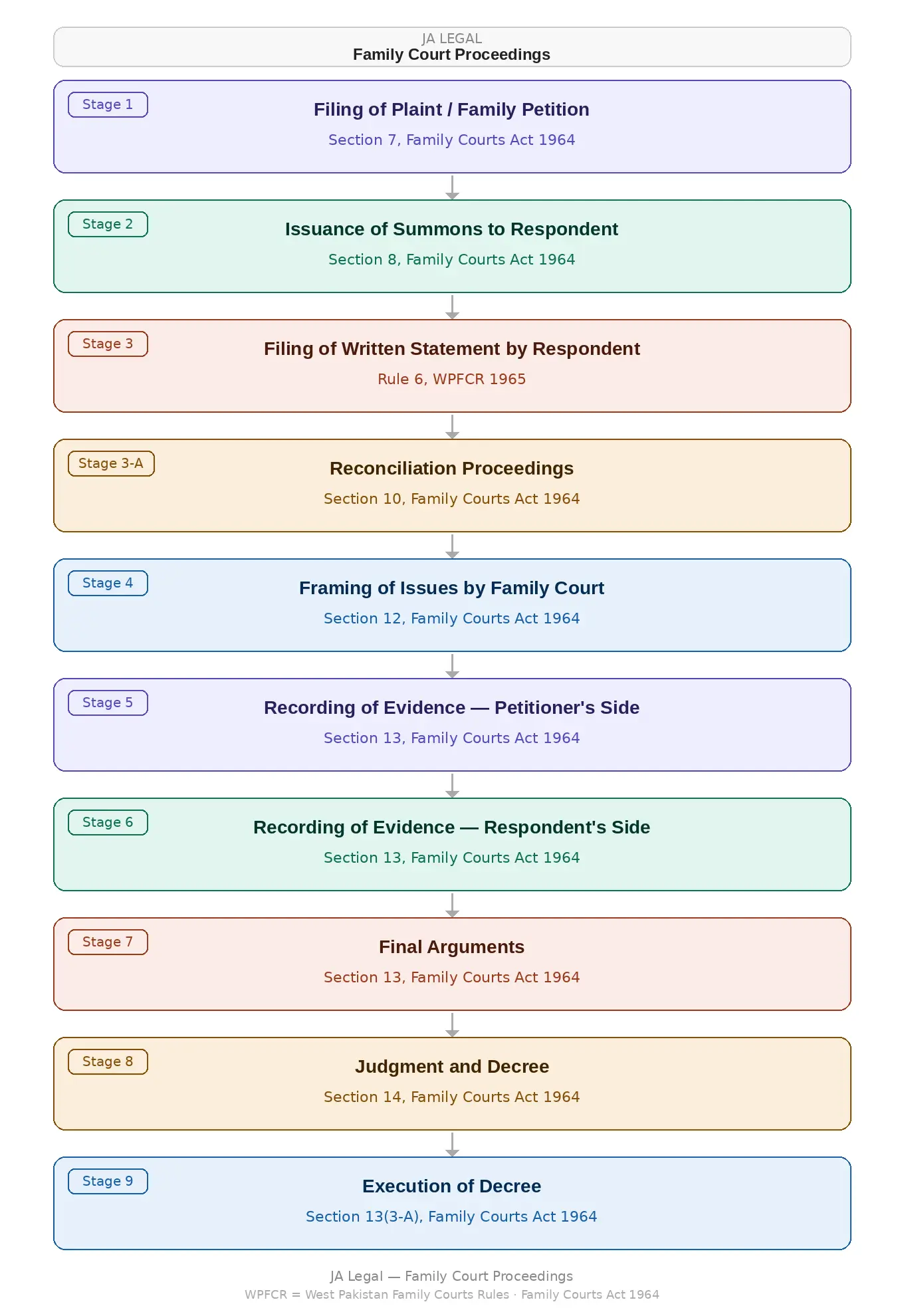
What Are the Stages of a Family Case in Pakistan?
The trial of a family law case in Pakistan is governed primarily by the Muslim Family Laws Ordinance, 1961 (“MFLO”), read together with the Family Courts Act, 1964 (“FCA”) and the West Pakistan Family Courts Rules, 1965 (“WPFCR”).
The principal stages, in their proper procedural order, are set out below.
What Family Law Services Are Offered by JA Legal?
JA Legal advises and represents clients across the full spectrum of family law in Pakistan, with a practice covering matrimonial disputes, guardianship, maintenance, and inheritance proceedings under the Muslim Family Laws Ordinance, 1961 (“MFLO”), the Family Courts Act, 1964, and the Muslim Personal Law (Shariat) Application Act, 1937. The firm’s family lawyers appear before Family Courts, the Courts of Session, the High Court of Sindh, and, in appropriate matters, the Supreme Court of Pakistan.
The firm’s family law practice is organized into the following five principal service areas:
| No. | Service Area | Scope of Engagement |
| 1 | Matrimonial Disputes and Dissolution of Marriage | Khula, judicial separation, and divorce proceedings under the Muslim Family Laws Ordinance, 1961; registration of talaq, recovery of haq mehr, and advisory on nikah validity |
| 2 | Child Custody, Guardianship, and Visitation Rights | Representation in custody and guardianship proceedings before Family Courts under the Guardians and Wards Act, 1890; applications for visitation rights, interim custody orders, and recovery of minor |
| 3 | Maintenance, Dower, and Financial Claims | Recovery of wife maintenance, child maintenance, and iddat allowance under the MFLO, 1961, and the West Pakistan Family Courts Act, 1964; enforcement of maintenance decrees and arrears recovery |
| 4 | Inheritance, Succession, and Property Disputes | Determination of legal heirs and distribution of estate under Muslim Personal Law; succession certificates under the Succession Act, 1925; partition suits and recovery of inheritance shares from co-sharers |
| 5 | Appeals, Revisions, and Constitutional Remedies | Family law appeals and revisions before the High Court of Sindh and the Supreme Court of Pakistan; constitutional petitions under Article 199 challenging illegal custody, procedural irregularities in family proceedings, and enforcement of foreign family court orders |
Detailed Description of Each Family Law Service Area covered by JA Legal
What Is Pre-Filing Advisory and Interim Relief in Family Law?
Pre-filing advisory in family law covers legal guidance before initiating court proceedings, including consultations on marriage registration disputes, reconciliation obligations, and interim maintenance claims. The practice includes:
- Pre-filing applications for interim maintenance under Section 17-A of the West Pakistan Family Courts Act, 1964 (“WPFCA”), before the Family Court;
- Applications for interim custody (“iddat” and “hizanat”) under Section 25 of the Guardians and Wards Act, 1890;
- Representation at pre-trial reconciliation proceedings mandated under Section 10 of the WPFCA;
- Petitions under Article 199 of the Constitution of the Islamic Republic of Pakistan, 1973, where family court orders are passed without jurisdiction or are vitiated by procedural mala fides;
- Advisory on registration, rectification, and cancellation of Nikahnama entries under the Muslim Family Laws Ordinance, 1961 (“MFLO”).
What Does Family Trial Court Representation Include?
Family trial court representation covers all proceedings from filing of suit to final decree before Family Courts across Pakistan. The scope extends from framing of issues to pronouncement of judgment and includes:
- Filing and conduct of suits for dissolution of marriage under Section 9 of the WPFCA, including Khul’ and judicial dissolution on grounds under the Dissolution of Muslim Marriages Act, 1939;
- Suits for recovery of dower (Mehr), deferred and prompt, under Section 5 of the MFLO;
- Recovery of maintenance for wife and children under Section 9 of the MFLO and Section 17-A of the WPFCA;
- Conduct of hizanat (child custody) suits under the Guardians and Wards Act, 1890, including cross-examination of witnesses and welfare reports;
- Recording and drafting of statements of parties under the WPFCA;
- Final arguments and submission of written synopses before Family Courts in Karachi and across Sindh.
What Are Restitution of Conjugal Rights and Dowry Recovery Matters?
Restitution of conjugal rights suits under Section 10 of the WPFCA compel an estranged spouse to resume cohabitation, subject to the court’s satisfaction that the separation lacks lawful cause. This practice area includes:
- Filing and defense of suits for restitution of conjugal rights before Family Courts;
- Recovery of Jahez (dowry) articles through suits for return of dowry property, supported by Jahez lists and witnesses;
- Recovery of Haq Mehr under prompt and deferred categories;
- Applications for attachment of property pending maintenance and dower decrees;
- Execution of family court decrees through attachment, arrest, and sale of property under Order XXI of the CPC as adapted by the WPFCA.
What Is Child Custody, Guardianship, and Visitation Practice?
Child custody in Pakistani family law is governed by the principle of child welfare under Section 17 of the Guardians and Wards Act, 1890, with hizanat (physical custody) of minor children presumptively resting with the mother until age 7 for boys and puberty for girls. This practice includes:
- Filing and conduct of guardianship petitions before Family Courts and the Guardian Judge;
- Applications for visitation rights (“mulaqaat”) and enforcement of visitation schedules;
- Custody modification applications where change in circumstances affects child welfare;
- International child relocation matters and applications under the Foreign Custody Orders (Enforcement) framework;
- Representation in matters involving parental abduction and recovery of minor children through constitutional petitions under Article 199.
What Are Appeals, Revisions, and Constitutional Remedies in Family Law?
Post-decree remedies in family law include appeals before the High Court, civil revisions, and constitutional petitions challenging illegal or jurisdictionally defective family court orders. This practice covers:
- Appeals against family court decrees on dissolution of marriage, maintenance, dower, and custody before the High Court of Sindh under Section 14 of the WPFCA;
- Civil revisions under Sections 115 of the CPC against interlocutory and final orders of Family Courts;
- Constitutional petitions under Article 199 of the Constitution challenging orders passed without jurisdiction, in excess of jurisdiction, or in violation of fundamental rights;
- Enforcement petitions for execution of maintenance and custody decrees where the judgment debtor resists compliance;
- Petitions for special leave to appeal before the Supreme Court of Pakistan under Article 185 of the Constitution in matters of significant legal importance involving family law.
JA Legal Handled these types of Family cases including :
Divorce and dissolution of marriage: under the Muslim Family Laws Ordinance, 1961 (MFLO), read with the Dissolution of Muslim Marriages Act, 1939. Family Courts exercise exclusive jurisdiction over dissolution suits.
Khula proceedings: under Section 8 of the Muslim Family Laws Ordinance, 1961. Family Courts grant khula on the wife’s application, with or without the husband’s consent, per the Supreme Court’s interpretation in Khurshid Bibi v. Muhammad Amin (PLD 1967 SC 97).
Child custody and guardianship: under the Guardians and Wards Act, 1890 (GWA), adjudicated by Family Courts. Welfare of the child is the paramount consideration per Section 17 of GWA, applied consistently in superior court judgments.
Child maintenance (nafaqa-e-aulad): under the Muslim Family Laws Ordinance, 1961, and the Muslim Personal Law. Fathers bear primary financial obligation for children’s maintenance until sons reach puberty and daughters marry.
Wife’s maintenance (nafaqa-e-zawja): under the Muslim Personal Law, enforceable through Family Courts. A wife retains the right to maintenance during the iddat period (90 days) following divorce, irrespective of financial status.
Dower (haq mehr) recovery: under the Muslim Family Laws Ordinance, 1961, and the Contract Act, 1872. Prompt dower is immediately recoverable upon demand; deferred dower becomes due on divorce or death of the husband.
Domestic violence protection: under the Domestic Violence (Prevention and Protection) Act, 2012 (Punjab); the Sindh Domestic Violence (Prevention and Protection) Act, 2013; and the Khyber Pakhtunkhwa Domestic Violence Against Women Act, 2021. Protection orders are issued by Family Courts and District Courts within 3 working days of application.
Succession and inheritance disputes: under the Muslim Personal Law (Shariat) Application Act, 1962, read with applicable Quranic shares (fara’id). Daughters inherit half the share of sons per Surah An-Nisa (4:11), enforceable through civil courts and Family Courts.
Restitution of conjugal rights: under Section 10 of the Family Courts Act, 1964. Family Courts adjudicate restitution suits; failure to comply within the prescribed period entitles the petitioning spouse to seek dissolution.
Dowry and bridal gifts recovery: under the Dowry and Bridal Gifts (Restriction) Act, 1976, read with provincial amendments. Dowry articles and bridal gifts remain the wife’s exclusive property, recoverable through Family Courts.
Guardianship of minors’ property: under the Guardians and Wards Act, 1890. District Courts appoint guardians for minors’ property where no testamentary guardian exists, with priority given to the natural guardian (father, then paternal grandfather).
Second marriage permission and registration: under Section 6 of the Muslim Family Laws Ordinance, 1961. An Arbitration Council’s prior permission is mandatory for second marriage; violation attracts imprisonment up to 1 year or fine up to Rs. 5,000, or both.
Birth, marriage, and divorce registration disputes: under the Births, Deaths and Marriages Registration Act, 1886, read with NADRA’s Registration Rules. Union Councils register nikah, divorce, and birth records; disputes over registration are adjudicated by civil courts and Family Courts.
Click here and read other Law services offer by JA Legal in Pakistan.
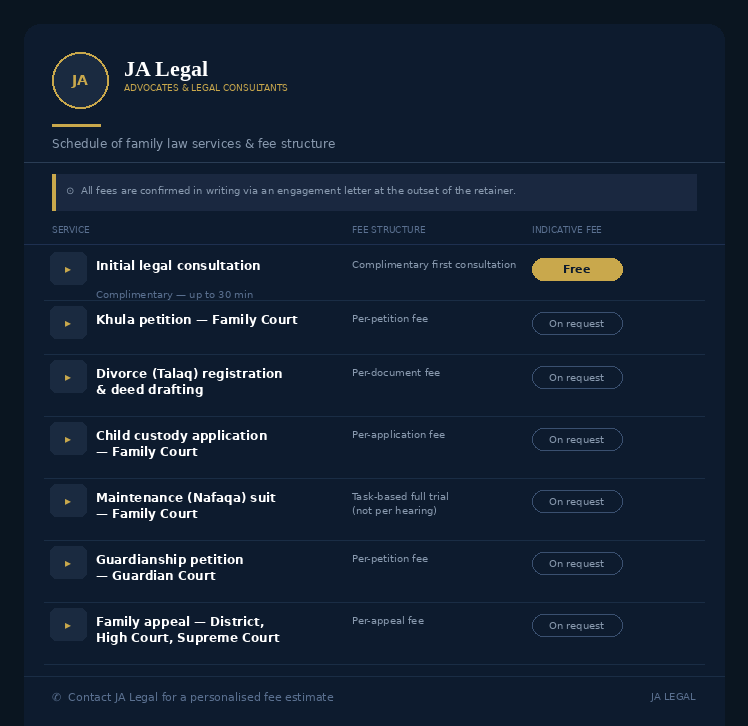
What is the Fee Structure for Family Law Services at JA Legal?
Professional fees in criminal matters are determined on a case-by-case basis, having regard to the nature and gravity of the offense, the forum of trial, the anticipated duration and complexity of the proceedings, and the seniority of counsel engaged.
By way of illustration, fees in a matter involving an offense punishable with death or imprisonment for life, such as one falling under Section 302 of the Pakistan Penal Code, 1860, will materially differ from those payable in a matter involving a comparatively less grave offense.
An indicative summary of the firm’s fee structure for the year 2026 is set out below. Final fee quotations are confirmed in writing via an engagement letter at the outset of the retainer.
How to Engage JA Legal in a Criminal Matter
Prospective clients may engage with the firm through either of the two following channels:
- In-person consultation at the firm’s office in Karachi (suitable for clients based in Karachi or those able to travel);
- Online or virtual consultation (suitable for clients based elsewhere in Pakistan or overseas).
Online and Virtual Consultations
JA Legal offers online and virtual consultations of up to thirty (30) minutes for clients who are unable to attend the firm’s Karachi office in person. The first such consultation is offered without charge. Appointments may be scheduled through any of the following:
- The contact form available on the firm’s website;
- WhatsApp;
- Direct telephone call through the firm’s Google Business Profile.
What is the process to schedule an online JA Legal appointment?
There are 5 simple steps to book your 30-minute online consultation with the JA Legal lawyer team.
- Contact via website, WhatsApp, or directly call from GMB(Google My Business profile)
- Provide a short description of the criminal matter, the type of offense you are facing
- Confirm your appointment date, time, and consultation fee structure with the JA Legal intake team.
- Confirm the availability of the JA Legal lawyer team on the same day as your meeting is scheduled.
- Prepare the relevant documents that convey your case details, including a copy of the FIR, arrest record, and court notices.